How to Grow Blueberries in Acidic Compost
Blueberries have a reputation for being difficult, and it is deserved — on one point only. They are not fussy about position, they shrug off most pests, and a well-grown bush will crop for a decade or more in the same pot. What they will not tolerate is lime. Get the compost right and the rest falls into place; get it wrong and you will spend years looking at yellowing leaves and handfuls of tiny fruit. This is how to hold the pH where it needs to be, whether you grow in containers or in open ground, and how to prune so the crop stays worth picking.
What pH actually does to a blueberry
Blueberries are calcifuge, which means they evolved in thin, acidic woodland soils and never developed a way of coping with lime. Above roughly pH 5.5, iron and other nutrients are locked up and unavailable, however well you feed. The first sign is usually pale leaves with darker veins in early summer. Growth slows, flowers drop, and any fruit that sets stays small and sharp.
Aim for pH 4.5 to 5.5, and test before you plant. A basic kit costs little and takes ten minutes. Most UK garden soils sit between 6.5 and 7.5, and anything over chalk or limestone is higher still. Lowering soil pH permanently is slow, and on alkaline ground it is close to impossible — which is why containers suit most gardeners better.
If your soil is already acidic
Gardens on sandy heathland, or in parts of Scotland and the west, may already test below pH 5.5. There, blueberries can go straight into the ground. Dig in plenty of composted bark or leafmould, plant 1.2 to 1.5 metres apart, and mulch each spring. Test again every couple of years, because pH creeps upwards over time.
Choosing plants that crop together
Plant two different varieties that flower at the same time. Bees then move pollen between them, and the berries are bigger and far more numerous. 'Duke' and 'Bluecrop' overlap well; 'Chandler' carries the season into late summer. Where space is tight, 'Sunshine Blue' is compact and partly self-fertile, though it still crops better with company.
Spreading your choices across early, mid and late varieties stretches the harvest from July into September. Buy pot-grown plants rather than bare-root where you can — they settle in faster and you can check the stems first. Look for firm, plump buds on strong one- and two-year-old wood, and walk away from anything with shrivelled, grey-tipped shoots.
Containers: the reliable route
Use a pot at least 35 to 40 centimetres across, or a 30-litre container. Blueberries root shallowly and widely rather than deeply, so a wide pot beats a tall one. Fill it with ericaceous compost — John Innes ericaceous holds moisture better than multipurpose — and mix in a couple of handfuls of bark or grit for drainage.
- Stand pots on feet so water drains freely; never leave them sitting in a saucer of standing water.
- Choose a spot in full sun, sheltered from strong wind, which shreds leaves and dries the compost.
- Repot every second or third winter, trimming the outer roots lightly and using fresh compost.
- In hard frosts, wrap the pot in bubble wrap or hessian; the roots are far less hardy than the top growth.
- Top-dress established pots with fresh ericaceous compost each March to replace what has washed through.
Watering and feeding
Rainwater is the single best investment you can make. Tap water in hard areas is alkaline, and used all summer it pushes compost pH upwards and leaves lime behind. A water butt connected to a shed roof will usually see a few pots through the season; if you must use tap water, use it fresh rather than stored.
Keep the compost evenly moist, especially while the fruit swells. A bush that dries out in July drops berries or produces small, hard ones, and shallow-rooted plants in pots dry faster than you expect. Water in the morning, right at the base of the stems.
Feed with an ericaceous fertiliser from March to July, following the packet rate, then stop. Late feeding pushes soft growth that will not harden before winter. Avoid general-purpose feeds, mushroom compost and most manure, which are either alkaline or too rich.
Pruning for a steady crop
Blueberries fruit best on one-year-old shoots and on canes between two and five years old. Left alone, a bush turns into a thicket of tired wood and the crop shrinks. Prune in late winter or early spring, from February to early March, while the plant is still dormant.
For the first two years, pinch off the flowers as they appear. It feels wasteful, but it lets the bush build a strong framework instead of spending everything on a few berries.
- Cut out dead, damaged and diseased canes first, back to clean wood.
- Remove low stems sprawling across the compost surface — they rarely crop and they keep the centre damp.
- Thin crowded, crossing and inward-growing twigs so light and air reach the middle.
- Take out one or two of the oldest, thickest canes at ground level to encourage replacement growth.
- Trim over-long canes by no more than a few centimetres, and leave the rest of the young wood alone.
Work gradually. Blueberries regrow from old wood far more slowly than raspberries, so removing a third of the bush in one go can cost you a season's fruit. On plants older than eight or ten years, renovate over two winters rather than one.
Birds, weevil and picking
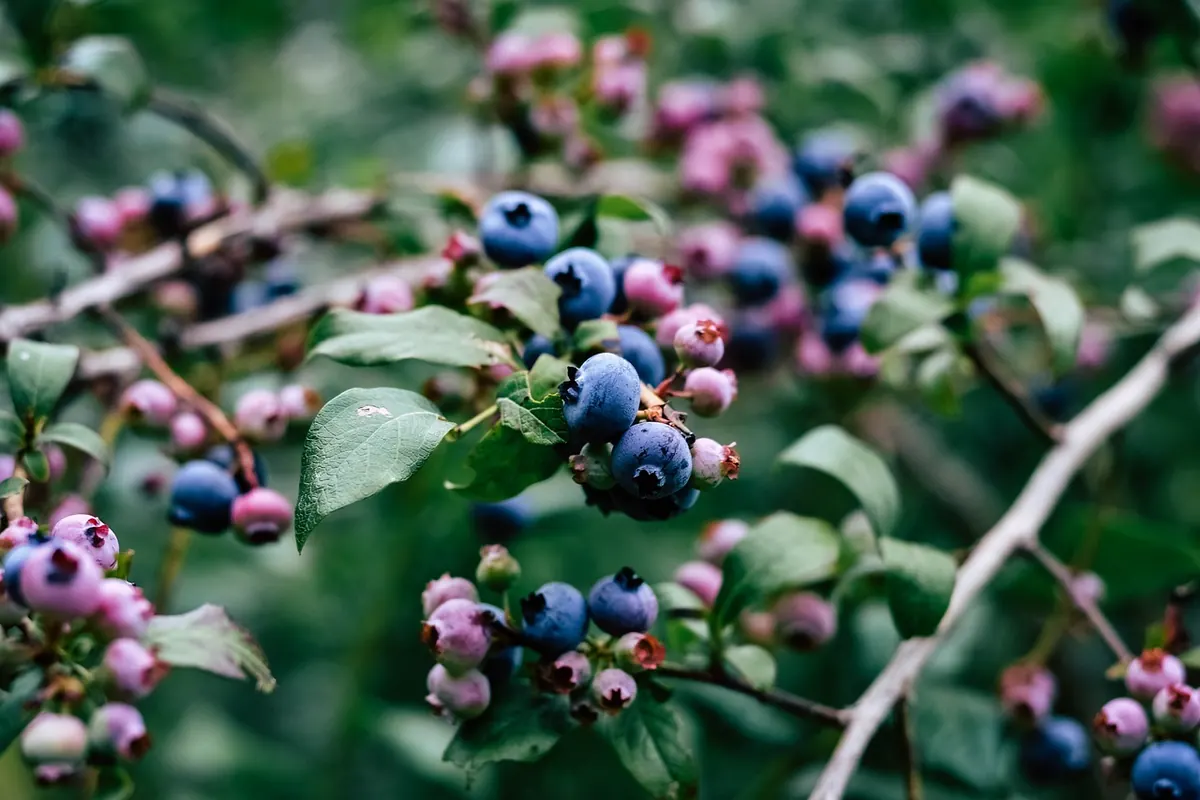
Birds are the main threat once the berries colour, and they work fast. Net the bushes from the moment the first fruit turns blue, using a frame so the mesh never touches the berries — birds peck straight through draped netting. Check the netting weekly for trapped wildlife.
In containers, watch for vine weevil. Notched leaves are a warning sign; if you tip a plant out in autumn and find fat white grubs among the roots, repot into fresh compost. Ripe berries come away with a gentle roll between finger and thumb, and they will not improve after picking, so taste one before you fill a punnet. Pick every few days through the season and freeze the surplus on trays before bagging it.
Your blueberry year at a glance
- January to February: prune, repot if needed, top-dress with ericaceous compost.
- March: start feeding; mulch ground-planted bushes with bark.
- April to June: water with rainwater, keep weeds down, net as soon as berries colour.
- July to August: pick every few days, keep watering, stop feeding by the end of July.
- October to December: clear fallen leaves, check pots are not waterlogged, protect against hard frost.
Do those things and a blueberry bush becomes one of the least demanding fruits in the garden. The compost matters more than the pruning, and the water matters more than both.
Photo: Veronicatxoxo / Pixabay
How to Cure and Store Onions and Garlic for Winter
Curing onions and garlic properly dries the necks and skins, so bulbs stay firm through winter. Here's how...

Composting in Winter: How to Keep Your Bin Working
A cold snap does not have to stop your compost bin. Here is how to insulate, turn and manage moisture so...